Doctrinal
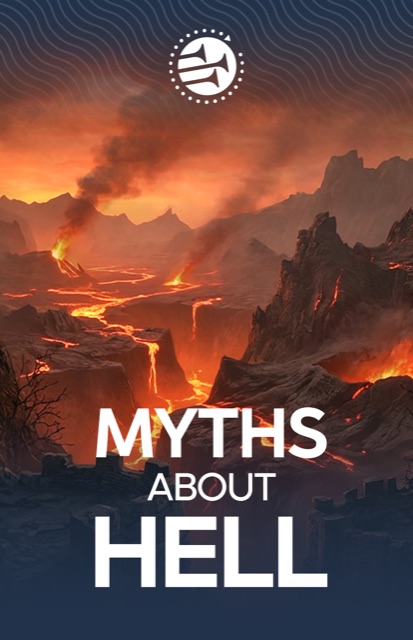
Myths About Hell
What does the Bible actually teach about hell? Common beliefs set beside Scripture.
What does the Bible actually teach about hell? This tract examines common beliefs about eternal punishment and compares them with biblical passages concerning death, judgment, fire, and the fate of the wicked. It presents the biblical picture of God’s justice and love while explaining the hope of eternal life for those who accept Jesus.
- Size
- 71 × 108 mm
- Languages
- English
Get this item
- Print PDF
- Digital PDF
Questions about ordering or customizing? Email us at info@globalbibleschool.org
For many, the image of hell is that of a horrific inferno where the damned are tortured and punished for all eternity. It’s no wonder most of us would be quite content if such a place just didn’t exist. In an attempt to rid their minds of such a fearful idea, some make the choice to disbelieve in hell altogether. This often leads to the next step: choosing to disbelieve in a God who would create such a horrible place.
How should we respond to this terrifying idea of hell or an underworld of punishment? Do we throw it—and God—out altogether? Do we try to ignore it and its implications about God? Or is it possible that what we’ve heard or been taught is mostly false? This pamphlet explores another option: to carefully consider what the Bible really has to say. Its truths can set us free from the various myths about hell.
When and Where?
The Bible provides clear answers about when hell will begin, where it will be located, and even when it will end—three points that are often misunderstood. In Matthew 13:49, 50 (KJV), Jesus says, “So shall it be at the end of the world: the angels shall come forth, and sever the wicked from among the just, and shall cast them into the furnace of fire: there shall be wailing and gnashing of teeth.” According to this text and many others like it,1 the flames of hell will not begin until the end of the world. In other words, no one is burning in hell right now!
The apostle Peter gives us clear information about the location of hell. Speaking of the end of the world, he says, “But the day of the Lord will come as a thief in the night, in which the heavens will pass away with a great noise, and the elements will melt with fervent heat; both the earth and the works that are in it will be burned up” (2 Peter 3:10). The prophet Zephaniah also speaks of “the whole land” being “devoured by the fire of His jealousy” (Zephaniah 1:18). These passages show that hell is not a giant flame-filled chasm in the center of the earth. Instead, it will be located right here on the surface of the earth at the end of the world—a fire devouring “the whole land.”
Who Will Live Eternally?
Perhaps the most important truth about hell is found in one of Scripture’s best-known verses, John 3:16: “For God so loved the world that He gave His only begotten Son, that whoever believes in Him should not perish but have everlasting life.” Here, Jesus clearly states that believers, not the wicked, live eternally. What? The wicked don’t live eternally in the flames of hell? Correct! Instead, they “perish.”
The wicked will burn only until nothing remains to be consumed. God explains this point in the book of Malachi: “‘For behold, the day is coming, burning like an oven, and all the proud, yes, all who do wickedly will be stubble. And the day which is coming shall burn them up,’ says the Lord of hosts, ‘that will leave them neither root nor branch.’” In order to confirm that He was speaking literally about the utter destruction of the wicked, He continues, “You shall trample the wicked, for they shall be ashes under the soles of your feet on the day that I do this” (Malachi 4:1, 3). In addition to destroying the wicked, hellfire will completely destroy Satan and his angels (Matthew 25:41; Ezekiel 28:18, 19). Contrary to popular belief, God plans to destroy the forces of darkness in hell, not place them in charge of it!
How Long Is Forever?
Some people might point out texts like Revelation 14:11 and 20:10 that say the wicked will burn “forever and ever.” In Scripture, the term forever indicates a time of indefinite duration in which the beginning and ending of the period depend on the nature of the person or circumstance to which it is applied. Hannah gave her boy Samuel to serve in the temple “forever,” but this meant “as long as he lives” (1 Samuel 1:22, 28). When Jonah was thrown into the sea and swallowed by a whale, he said he was there “forever” (Jonah 2:6). It may have felt like forever to Jonah, but he was in the belly of the whale for only three days and nights (Jonah 1:17). In our day, a man and woman commit to their marriage vow “forever,” but this forever simply means as long as they both live.
So, how do we understand the meaning of hellfire’s forever? When we allow Scripture to define the term, we discover that forever means until the wicked are utterly consumed and turned to ashes.2 The fire, smoke, and torment only continue until the wicked are finally annihilated. In fact, Revelation 14:9–11 reflects Isaiah 34:8–10, where similar forever language is used to describe the total destruction of Edom, which is clearly not burning today.
In light of this Bible study, one might ask how these myths about hell continue to be taught. This false teaching has permeated Christianity not just because it’s a good scare tactic to drive church attendance, but because our adversary the devil loves to teach lies about God. Revelation 12:9 describes Satan as the one “who deceives the whole world.” He deceives them about our loving and fair God and accuses Him of being cruel and sadistic. But what is the truth?
The Consuming Fire of God’s Love
Our God is a “consuming fire” to sin and sinners (Hebrews 12:29). For this reason, the wicked cannot exist in the presence of God. The saved person, on the other hand—the one “who walks righteously and speaks uprightly”—is the only one who can “dwell with the devouring fire” and “everlasting burnings” (Isaiah 33:14, 15). According to Matthew 25:31–46, all humanity will one day encounter God, in Whose presence “the hills melt, and the earth is burned” (Nahum 1:5, KJV). Those who have repented of their sins and accepted Jesus as their personal Savior will be protected in His fiery presence, where they will live for eternity; for “he who has the Son has life; he who does not have the Son of God does not have life” (1 John 5:12). The wicked, on the other hand, will cease to exist and “be as though they had never been” (Obadiah 16) after they are “punished with everlasting destruction from the presence of the Lord and from the glory of His power” (2 Thessalonians 1:9).
Friend, “God is love” (1 John 4:8), and it’s a love symbolized as “a most vehement flame” (Song of Solomon 8:6). As fire melts ice but hardens clay, so His fiery love will comfort the saved but consume the wicked. Today, will you allow His flames of truth and love to melt your heart? Your choice will determine your eternal destiny. Seek Him today, and His love will warm your heart with joy and peace through all eternity!
Endnotes
1 See also Matthew 25:31–46; 2 Peter 3:3–7, 12; Revelation 20:5, 11–15.
2 See, for example, Psalm 37:9, 10, 20.
Unless otherwise noted, Scripture is taken from the New King James Version®. Copyright © 1982 by Thomas Nelson. Used by permission. All rights reserved. Bible text credited to KJV is from The Holy Bible, King James Version, public domain. Emphases have been supplied.