Doctrinal
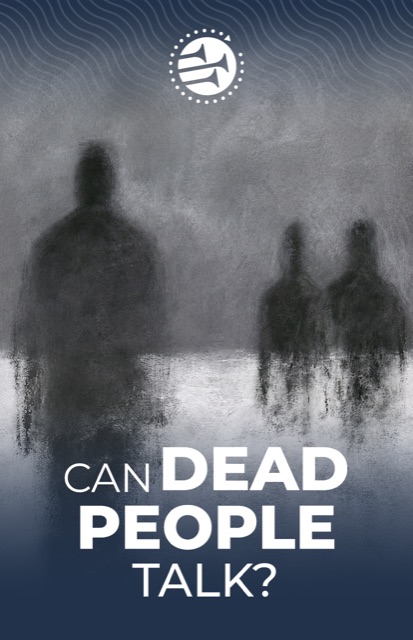
Can Dead People Talk?
What happens when we die? What the Bible teaches about death, the soul and resurrection.
What happens to us when we die? Through the story of a grieving man who encounters what appears to be his deceased mother, this tract examines the Bible’s teachings about death, the soul, resurrection, and spiritualism. It explains why the Bible teaches that the dead are unconscious and warns about spiritual deception while pointing readers toward the biblical hope of resurrection and eternal life through Jesus.
- Size
- 71 × 108 mm
- Languages
- English and Spanish
Get this item
- Print PDF
- Digital PDF
Questions about ordering or customizing? Email us at info@globalbibleschool.org
When Mark’s mother died suddenly, he was utterly heartbroken. Throughout his life, he had been close to his mother. As this new reality set in, Mark began to long for an opportunity to see her just one more time and tell her he loved her.
Then, it happened. One day while Mark was at home, he heard a familiar voice. His heart began to beat rapidly. As he turned around, he couldn’t believe his eyes. His mother stood before him! Everything about her indicated that it was her—her glowing smile, her kind voice, her mannerisms. He felt like he was in a dream, and his mind raced with questions: Didn’t Mother just die? How can she be here in my home?
As though she read his mind, Mark’s mother began to explain that she was sent from heaven to tell him that she was doing well. From that time forward, she would visit him periodically in his home.
At first, Mark was elated, but as the visits continued, things took a turn. His “mother” began encouraging him to join her in heaven. This idea alarmed Mark; he didn’t want to take his own life. So, he decided to seek help and reached out to a pastor from whom he learned a shocking truth about these visits from his “mother.” What did he learn? Keep reading to find out!
Death and Spiritualism
Spiritualism is the belief that people can and do communicate with the spirits of the dead. People practice spiritualism in a variety of ways. Some people seek direct contact with spirits. Others attempt to communicate with the dead through third-party mediums or various forms of witchcraft or sorcery.
In the Bible, though, God warns His people to avoid participating in any form of spiritualistic practice. He gave His people clear instructions: “There shall not be found among you anyone who makes his son or his daughter pass through the fire, or one who practices witchcraft, or a soothsayer, or one who interprets omens, or a sorcerer, or one who conjures spells, or a medium, or a spiritist, or one who calls up the dead. For all who do these things are an abomination to the Lord . . .” (Deuteronomy 18:10–12). When life gets challenging, many people seek guidance and counsel from spirits that appear to be familiar loved ones—a father, mother, uncle, aunt, sibling, or close friend. However, God strictly forbids His people from attempting to communicate with the dead or consulting mediums and spiritists (Leviticus 19:31; 20:27).
Instead, God invites His people to come directly to Him through prayer and the study of His Word to find answers for their lives (Isaiah 8:19, 20). This is very important! God gives open access to anyone who desires to come to Him. However, nobody should try to come to God by attempting to contact the dead. Let’s explore the reason.
The Truth About Death
Why does God forbid His people from trying to contact the dead? It’s because these “spirits of the dead” are not what they seem. Many people are surprised to learn that according to the Bible, it’s simply not possible for dead people to communicate with us. The Bible describes death as total silence. “The dead do not praise the Lord, nor any who go down into silence” (Psalm 115:17).
Why are dead people not praising the Lord? The Bible teaches that while they are dead, they do not have thoughts or feelings of any kind. They are unconscious and unaware of anything. For example, Scripture says, “For in death there is no remembrance of You [God]; in the grave who will give You [God] thanks?” (Psalm 6:5). Another Bible verse says, “For the living know that they will die; but the dead know nothing. . . . Also their love, their hatred, and their envy have now perished . . .” (Ecclesiastes 9:5, 6). Contrary to popular belief, death is not some mysterious transition into another form of life or some alternative reality. Rather, death is an unconscious state that continues until the resurrection.
Somebody may ask, “But don’t dead people go to heaven?” The Apostle Peter answered this very question when he preached in Jerusalem. Speaking about the Old Testament hero David, he told his audience, “He is both dead and buried, and his tomb is with us to this day” (Acts 2:29). For clarity, he added, “David did not ascend into the heavens” (Acts 2:34). The Bible is clear that God’s people who have passed away wait in the grave until the resurrection when Jesus will come in the clouds of heaven to receive His own and take them home with Him to heaven (1 Thessalonians 4:15–17). Because there is no consciousness in death, a thousand years or more will seem like the blink of an eye to those who rest in the grave. When a person dies in the Lord, their next conscious moment will be when they see Christ coming in the clouds to receive His people.
But what about the soul? Isn’t the soul the part of a person that never dies? Scripture challenges this idea as well. Carefully consider what this statement means: “The soul who sins shall die” (Ezekiel 18:4, 20). Everything that is true about death applies to the soul as well. Scripture plainly teaches that human beings don’t have immortal souls. God alone has immortality (1 Timothy 6:16). God will give immortality to His faithful people in the future, when the dead are resurrected and taken with Him to heaven (1 Corinthians 15:52–54; John 6:39, 40).
But Why Does It Matter?
Unfortunately, many Christians have accepted the belief that human beings have an immortal soul that continues to exist consciously after the body dies. From a biblical perspective, this mistaken belief provides a wide-open opportunity for evil spirits or demons to trick them. How? Demons can disguise themselves as their departed loved ones and make it seem like those loved ones are enjoying the bliss of heaven—when in fact they are asleep in the grave with no consciousness whatsoever. Such was the case with Mark and the spirit that posed as his mother and attempted to coax him into taking his own life.
Jesus told His disciples that shortly before His second coming, false christs and false prophets would appear and work very impressive miracles to “deceive, if possible, even the elect” (Matthew 24:24). One of Jesus’ most ardent followers, the Apostle Paul, warned of something similar: “The coming of the lawless one is according to the working of Satan, with all power, signs, and lying wonders, and with all unrighteous deception among those who perish . . .” (2 Thessalonians 2:9, 10). The Bible’s teachings about spiritualism and death will become increasingly relevant as we get closer to the end of the world and Satan’s deceptions become more intense.
But those who trust Jesus and His Word will be safe. Jesus will give eternal life to each person who accepts His sacrifice on the cross and trusts His promise: “I will raise him up at the last day” (John 6:40).Will you invite Him into your life today and receive His promise of resurrection to eternal life in His kingdom? And will you trust what the Bible teaches about death?
Scripture is taken from the New King James Version®. Copyright © 1982 by Thomas Nelson. Used by permission. All rights reserved.